
Do You Really Need to Buy Everything Organic?
GARDENHOLISTIC HEALTH
6/6/2026
I get asked this a lot. Organic produce can be significantly more expensive, and for many of us, buying everything certified organic simply isn't realistic every week. The good news is that you don't have to.
Every year, the Environmental Working Group (EWG) publishes its Shopper's Guide to Pesticides in Produce, analysing thousands of samples of conventionally grown fruit and vegetables to identify which carry the highest and lowest pesticide loads. Their 2026 report is now out, and alongside the familiar Dirty Dozen and Clean Fifteen lists, it carries something new worth paying attention to: the presence of PFAS chemicals (per- and polyfluoroalkyl substances), the so-called "forever chemicals," detected on produce for the first time.
I want to share the key findings with you, and give you a simple, practical framework for making organic choices without overhauling your entire food budget.
What the 2026 report found
Three-quarters of non-organic produce samples contained pesticide residues, even after washing and preparation. That sounds alarming, but context matters here. The EWG itself is clear that the goal of this research is not to frighten people away from fruit and vegetables. Eating plenty of plants remains one of the most important things you can do for your health. The lists are a tool for prioritising, not a reason to avoid the produce aisle.
What is new this year is the PFAS finding. 63% of Dirty Dozen samples contained PFAS pesticides, a class of synthetic chemicals known as "forever chemicals" for their persistence in the body and environment. The most commonly detected was fludioxonil, a fungicide found in 14% of all produce tested, including in nearly 90% of peaches and plums. These are not residues that washing removes. They accumulate, both in crops and in the body, and research into their long-term effects is still ongoing.
As a herbalist, this matters to me beyond the dinner plate. Many of the plants we use medicinally, whether as food, infusion, or remedy, overlap directly with the crops on these lists. If you are drinking nettle tea, adding spinach to your morning smoothie for its iron content, or reaching for berries as a daily antioxidant food, the question of what else you are consuming alongside those nutrients is a fair one.
A note if you're reading this from Europe
The EWG's research is based on US Department of Agriculture testing data, and it is worth knowing that the picture here in Europe looks somewhat different. The EU operates a precautionary principle when it comes to pesticide regulation, meaning that a substance can be restricted or banned if there is reasonable doubt about its safety, even before conclusive proof of harm exists. The US regulatory system has historically taken the opposite approach, permitting use until harm is demonstrated.
Chlorpropham, for example, the sprout inhibitor found in 90% of US potato samples, is already banned in the EU due to health concerns. Many of the fungicides flagged in this report are either prohibited or used at significantly lower permitted levels across European agriculture. If you are shopping at a Portuguese mercado, a French marché, or a local farm shop anywhere in Europe, your baseline exposure is generally lower than the US data suggests.
That said, the relative ranking still holds. The crops that attract the heaviest pesticide use in the US tend to attract the most in Europe too. Strawberries, leafy greens and stone fruit are still worth buying organic when you can, wherever you are.
The 2026 Dirty Dozen - where to prioritise organic
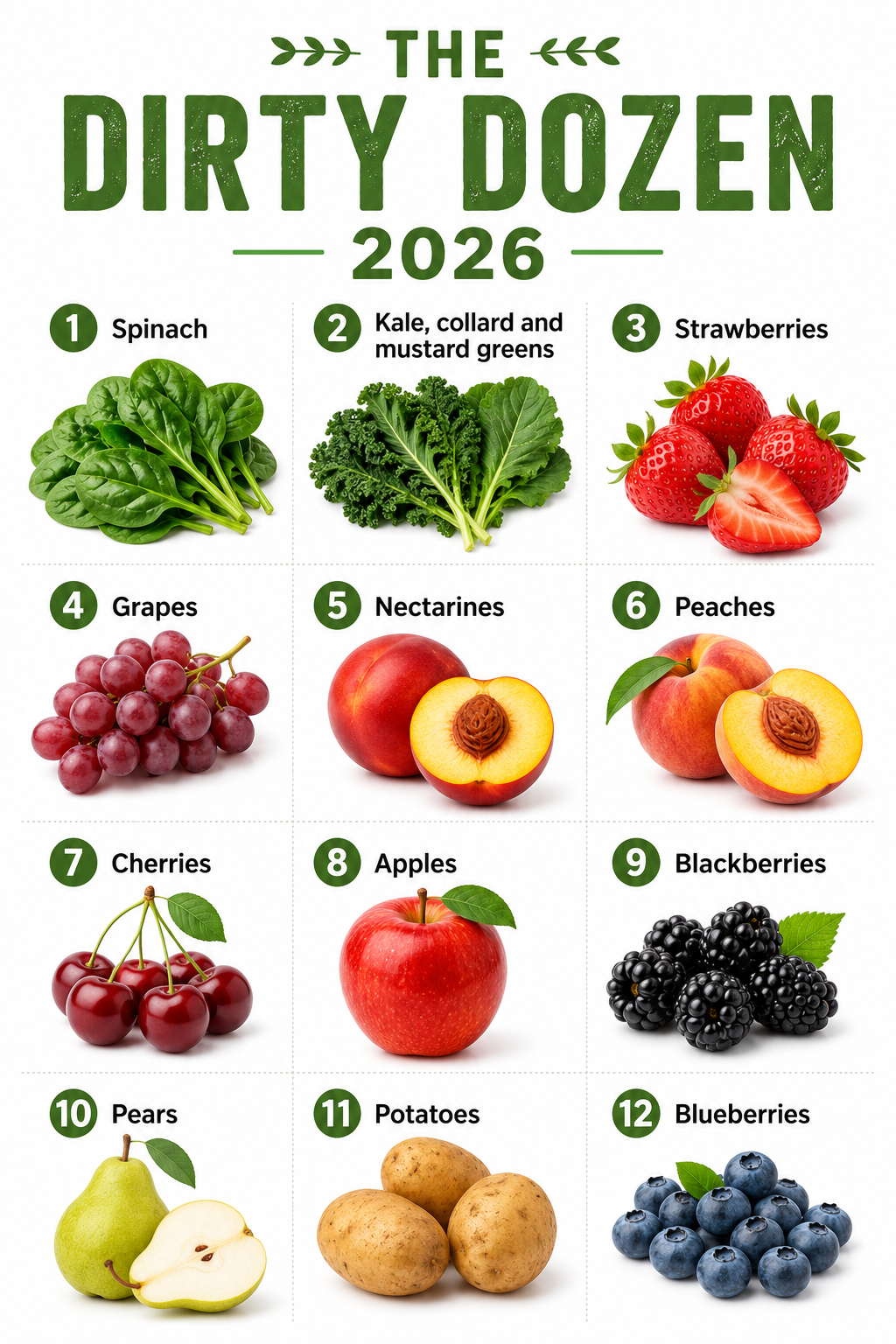
Topping the 2026 list on the basis of both the level and toxicity of detected pesticides are spinach, kale, collard and mustard greens, strawberries, grapes and nectarines. Blackberries carried an average of more than four pesticides per sample, with one sample showing 14 pesticide residues!
If your budget is tight, focus your organic spending on this list, especially the leafy greens, berries and stone fruit at the top. These are also the foods most likely to be eaten raw and in quantity, which matters.
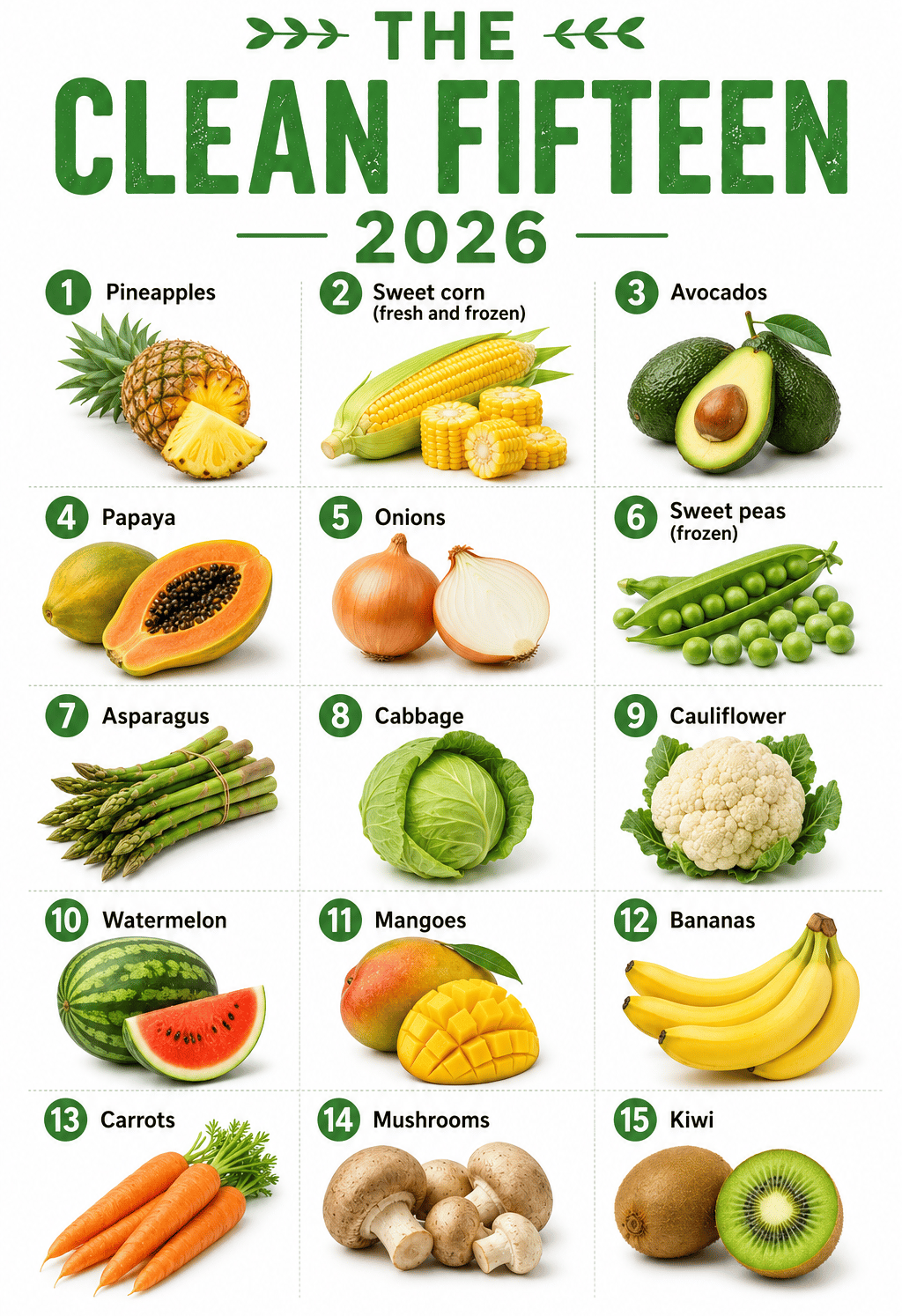
The 2026 Clean Fifteen - where conventional is fine
Almost 60% of Clean Fifteen samples had no detectable pesticide residues at all. These are the items where you can confidently buy conventional and put the money saved towards organic versions of the Dirty Dozen.
A practical approach that actually works
Here is how I think about this, and what I suggest to clients who want to eat more cleanly without spending a fortune:
Learn the top five by heart. Spinach, kale and leafy greens, strawberries, grapes and nectarines are consistently among the worst offenders year on year. If you remember nothing else from this list, go organic on these.
Buy Clean Fifteen freely. Avocados, pineapple, onions, cabbage and cauliflower are genuinely fine to buy conventional. You get full nutritional benefit without the pesticide burden.
Consider frozen for berries and greens. Frozen organic berries and spinach are almost always cheaper than fresh organic equivalents, and nutritionally comparable. This is especially worth knowing if you use them regularly in smoothies or cooking.
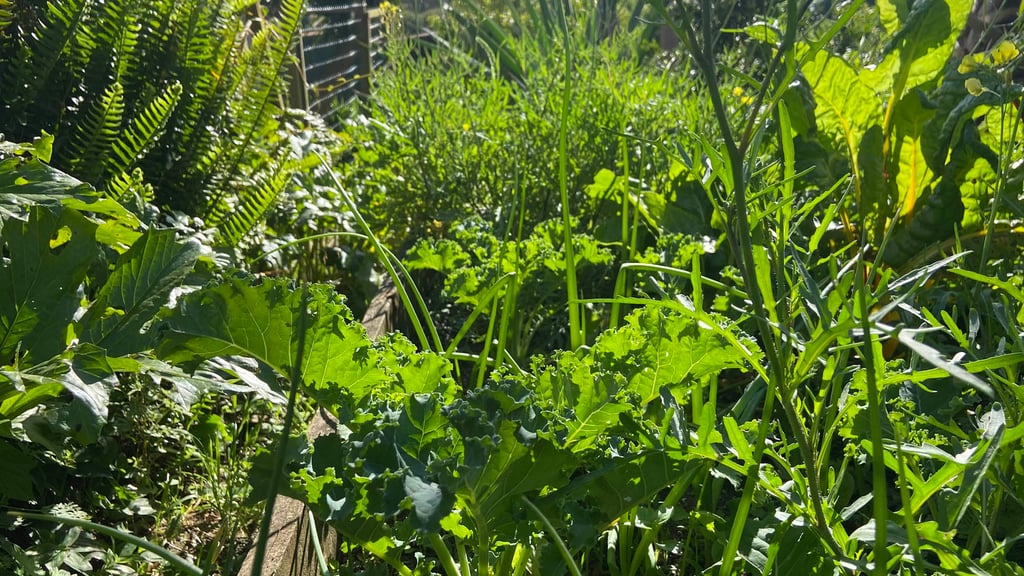
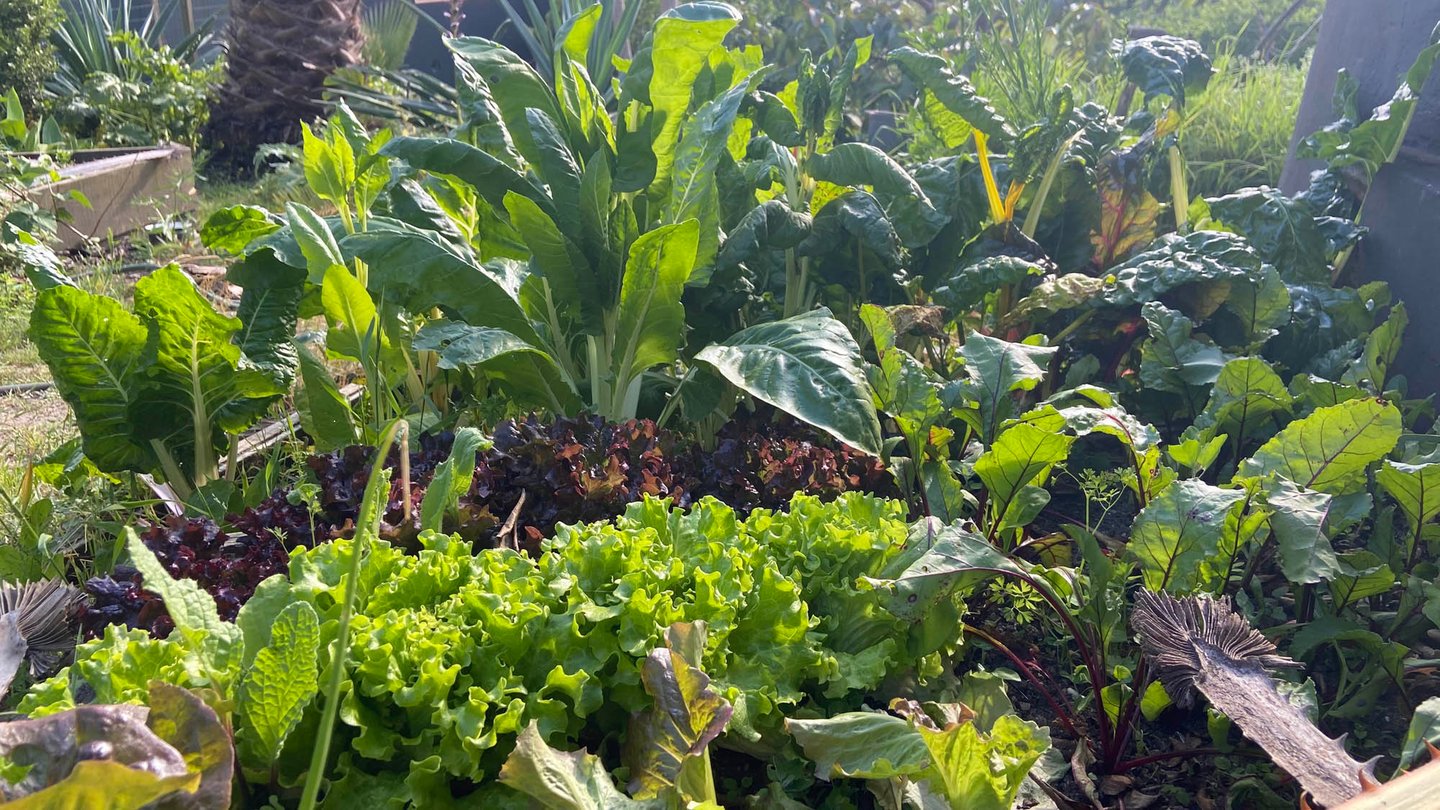
Grow what you can. Even a windowsill pot of herbs shifts something. Spinach, kale, strawberries and salad leaves are all straightforward to grow at home, and anything you grow yourself is as organic as you choose to make it. I grow a lot of what I use daily here in my garden in Portugal, and even a small patch makes a real difference, practically and philosophically. If you want to go a step further and work with the rhythms of the moon in your growing, my Biodynamic Moon Garden Calendar is a good place to start. It covers 53 plants across the four biodynamic day types and is designed to help you grow with more intention, whether you have a full garden or a few pots on a balcony.
Wash everything. Washing does not remove all residues, particularly not PFAS, but it does reduce surface contamination. Do it regardless of whether produce is organic or conventional.
Surely we can do better than this?
I want to say something that goes beyond the shopping list, because I think it needs saying.
Food is fundamental. It is not a luxury. Every person on this planet, regardless of income, geography or circumstance, deserves to eat food that nourishes rather than harms them. Clean, unadulterated food is not a premium option. It is a basic human right. And yet here we are, in the 21st century, with the scientific knowledge, the agricultural technology and the collective resources to feed the world well, and we are still having conversations about which vegetables are safe to eat without a side order of synthetic chemicals.
We know that many of these substances are harmful. We know that some of them accumulate in the body over time. We know that children, pregnant women and people with compromised health are most vulnerable. And we know, because the EU has demonstrated it, that farming without many of these chemicals is entirely possible. The choice to permit them is a political and economic one, not an agricultural necessity.
I am not naive about the complexity of global food systems. Farmers are often caught between economic pressures and consumer expectations that make chemical-free growing feel out of reach. That is a systemic problem, not a personal failing. But I do believe that the direction of travel matters, and that every choice we make as consumers, every time we support organic growers, grow a little of our own, or simply ask questions about where our food comes from, nudges that system in a better direction.
We deserve better. All of us. And I think, quietly but firmly, we should keep saying so.
The bigger picture
Choosing organic where it counts most is a meaningful step, and so is growing your own, buying from local growers you trust, and being thoughtful rather than anxious about the whole thing.
You do not need a perfect trolley. You just need a few clear priorities, and a little more connection to where your food comes from. The calendar can help with that second part, if you're curious.
References
Environmental Working Group (2026). Shopper's Guide to Pesticides in Produce. ewg.org/foodnews
Environmental Working Group (2026). EWG's 2026 Shopper's Guide to Pesticides in Produce finds widespread pesticide residue, including PFAS forever chemicals. ewg.org/news-insights/news-release/2026/03/ewgs-2026-shoppers-guide-pesticides-producetm-finds-widespread
Food Safety Magazine (2026). EWG Publishes 2026 'Dirty Dozen' List of Pesticide-Contaminated Produce. food-safety.com/articles/11266-ewg-publishes-2026-dirty-dozen-list-of-pesticide-contaminated-producebut-is-it-scientifically-sound
Bo-tanics Aroma-Herbary
W E L C O M E T O T H E G A R D E N

© bo-tanics.com 2026 design by thebodesign.com Privacy Policy Terms & Disclaimer