
How Much Do You Actually Need to Grow to Feed Yourself for a Year?
GARDENHOLISTIC HEALTH
6/12/2026
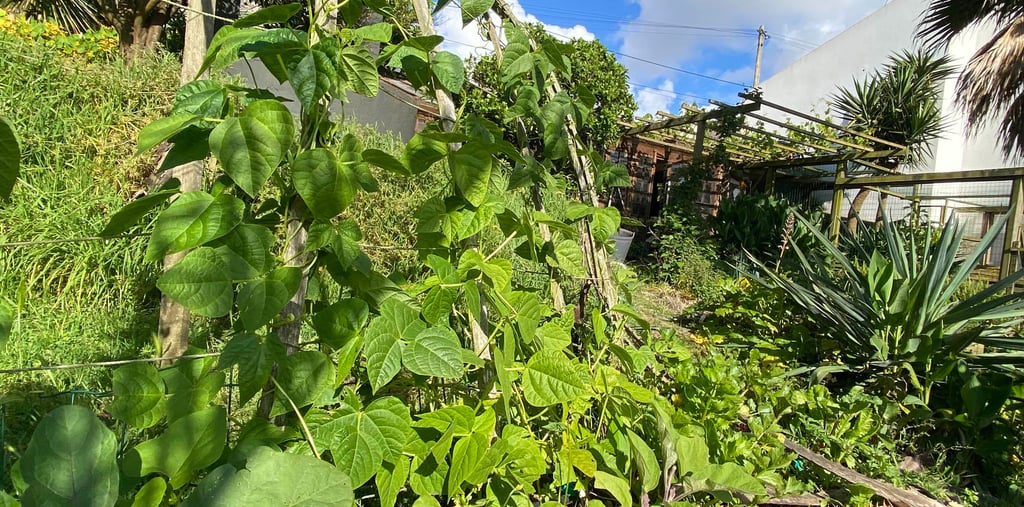
There is something quietly radical about the idea of growing your own food. Not as a hobby, not as a weekend project, but as a genuine contribution to what lands on your table every day. If the last post got you thinking about what is on your vegetables, this one is about taking the next step: what would it actually look like to grow a meaningful portion of your own food for a year?
I want to be honest upfront. Growing a full year's supply for one person, let alone two, is a significant undertaking. It requires space, planning, and a decent amount of patience in the first season while you find your rhythm. But it is also far more achievable than most people assume, particularly here in Portugal, where the climate is one of the most generous in Europe for year-round growing. Zone 10 is a genuine gift to the kitchen gardener, and most of us are not making nearly enough use of it.
This post is for everyone from the first-time grower with a few raised beds to the smallholder with a quinta and ambitions to match. The numbers scale, and I will show you how to think about them.
Why Portugal changes everything
Most growing guides you will find online are written for the UK, northern Europe or the northern United States. They assume a growing season of roughly five to six months, with hard frosts halting everything from October through to March. That is not our reality here.
In Zone 10, which covers much of the Algarve, the lower Alentejo and the coastal areas of the Silver Coast, we have what is effectively a twelve-month growing season for many crops. Winters are mild and mostly frost-free. Summers are long, hot and dry, which means summer crops like tomatoes, peppers, courgettes and aubergines thrive here in a way they simply cannot further north.
The main adaptation to make is this: our seasons are almost inverted compared to northern Europe for cool-weather crops. Spinach, kale, lettuce, broad beans and peas do best sown in autumn and grown through winter here, not in spring. Tomatoes, peppers and cucumbers go in from March onwards and produce abundantly through summer and into autumn. Understanding this rhythm is the single most important thing you can do to get more from your growing space.


A note on what these numbers assume
These quantities assume you are eating seasonally, preserving some of what you grow (drying, freezing, making sauces and pickles), and supplementing with other foods rather than trying to be completely self-sufficient. True full self-sufficiency from vegetables alone requires significantly more space and planning, and is a different project entirely.
They also assume reasonable soil and watering through the dry months. In Portugal's summer, irrigation is not optional for most crops. A simple drip system makes an enormous difference to both yields and the amount of time you spend in the garden each day.
Portugal's seasonal planting guide
This is a rough framework for Zone 10. Local microclimates vary, particularly at altitude or in areas that do experience occasional frost, so treat it as a starting point.
Autumn (September through November): garlic, broad beans, peas, spinach, kale, lettuce, onions, carrots, beetroot, chard, turnips, broccoli, cauliflower. This is one of the most important sowing windows of the year here and the one that northern European guides will never tell you about.
Winter (December through February): continue harvesting cool-season crops, start tomatoes and peppers under cover from late January, chit potatoes.
Spring (March through May): tomatoes out from March, peppers, courgettes, cucumbers, aubergines, French beans, sweet corn, pumpkins, sweet potatoes from April. Second sowings of carrots, lettuce and beetroot.
Summer (June through August): harvest heavily, water consistently, sow fast-maturing salads in the cooler parts of the day. Begin thinking about autumn sowings from late August.
Starting small and scaling up
If this feels like a lot, it is worth knowing that most experienced growers arrived at these numbers gradually. A first garden year is about learning what grows well in your particular patch, what you actually eat enough of to warrant the space, and where your time and water are best spent.
A good starting point for one person is to focus on five to eight crops that appear on the Dirty Dozen list (the previous post has the full 2026 list). Spinach, kale, strawberries, peppers and leafy greens are all straightforward to grow here, all appear on the most heavily sprayed list, and all represent genuine savings in both money and chemical exposure when you grow them yourself.
From there, add a couple of high-yielding easy wins: courgettes, chard and tomatoes reward relatively little effort with a great deal of food.
The bigger picture
Growing your own food, even a fraction of it, changes your relationship to eating in ways that are difficult to describe until you have experienced them. There is a quality to a tomato you have watched ripen on the vine, or spinach cut twenty minutes before it reaches your plate, that supermarket produce simply cannot replicate, organic or otherwise. That quality is not just nutritional, though it is that too. It is a kind of aliveness. A reminder that food is not a product. It is a process, rooted in soil and season and patience.
We are lucky to live somewhere that allows us to participate in that process for most of the year. That feels worth taking seriously.
If you want to bring a little more rhythm and intention to your growing, my Biodynamic Moon Garden Calendar covers sowing and tending by lunar cycle and biodynamic day type across 53 plants. It sits well alongside a seasonal planting plan like this one.
Bo-tanics Aroma-Herbary
W E L C O M E T O T H E G A R D E N

© bo-tanics.com 2026 design by thebodesign.com Privacy Policy Terms & Disclaimer