
What Are Biodynamic Planting Days?
GARDENLUNAR
Bo-tanics
5/9/2026
If you have ever encountered a biodynamic calendar and wondered what on earth a "root day" or a "flower day" actually means in practice, this post is for you.
Biodynamic planting days are not complicated once you understand the basic logic behind them. They are one of the most practical tools available to herb growers, and once you start using them, it becomes difficult to imagine gardening any other way.
Let me walk you through the four types, what they mean, and - most importantly - what to do with that information if you are growing medicinal herbs.
Where the system comes from
The biodynamic planting calendar was developed primarily through the work of Maria Thun, an Austrian farmer who began systematic observation experiments in the 1950s. Over decades of field trials, she observed that planting, tending, and harvesting at different points in the lunar and zodiac cycle produced measurable differences in plant health, yield, and quality.
Her work identified a relationship between the position of the moon in the zodiac and the part of the plant that responds most strongly to cultivation at that time. This became the foundation of the four day types: Root, Flower, Fruit and Leaf.
Each day type is linked to a natural element.
Root Days
Element: Earth
Zodiac signs: Taurus, Virgo, Capricorn
Root days are associated with the earth element and the underground parts of plants: roots, bulbs, rhizomes, tubers. On root days, the energetic focus of the plant is drawn downward. This makes root days ideal for:
Sowing and transplanting root crops and root-dominant herbs
Harvesting roots intended for medicinal use (think valerian root, marshmallow root, ashwagandha)
Dividing root clumps and taking root cuttings
Applying compost or soil amendments, since the earth's receptivity is considered stronger
For medicinal herbalists, root days are significant because many of the most important adaptogenic and nervine herbs are valued specifically for their roots. Harvesting on a root day, ideally in the afternoon when the plant has been drawing energy upward through the day, tends to produce roots with richer colour, denser texture, and stronger aroma.
Flower Days
Element: Air
Zodiac signs: Gemini, Libra, Aquarius
Flower days are some of the most sought-after days in the biodynamic calendar for medicinal herb growers, and for good reason. On flower days, the plant's vitality is concentrated in its reproductive structures. Flowers are more vibrant, more aromatic, and more potent. This makes flower days ideal for:
Harvesting flowers at peak medicinal and aromatic quality (chamomile, calendula, elderflower, lavender, meadowsweet)
Sowing annual flowers and flowering herbs
Making flower essences, floral tinctures, and infused oils from blooms
Pruning flowering shrubs to encourage more abundant flowering
Many herbalists and aromatherapists notice a marked difference in the fragrance intensity and staying power of dried flowers harvested on flower days compared with those harvested at random. If you make your own flower essences, harvesting on a flower day in good sunlight is considered the gold standard.
Fruit Days
Element: Fire
Zodiac signs: Aries, Leo, Sagittarius
Fruit days correspond to the fire element and focus on the seed-bearing parts of plants: fruits, seeds, and pods. On fruit days, the plant's energy is concentrated in its ability to reproduce. This makes fruit days ideal for:
Harvesting fruits, berries, and seeds intended for consumption or for replanting
Sowing plants that are grown primarily for their fruit or seed (fennel seeds, coriander seeds, milk thistle seeds)
Preparing seed-based remedies and preparations
Drying seeds for long-term storage
Fruit days are less central to a primarily medicinal herb garden than flower and root days, but if you are growing fennel, milk thistle, or any herb where the seed is the medicinal part, paying attention to fruit days can meaningfully improve your harvest quality.
Leaf Days
Element: Water
Zodiac signs: Cancer, Scorpio, Pisces
Leaf days bring the plant's vitality into its leafy, green, growing parts. They are associated with the water element and the vegetative, expansive energy of growth. On leaf days, the plant is directing its resources toward lush, green growth. This makes leaf days ideal for:
Harvesting leafy herbs intended for fresh use, culinary use, or drying (lemon balm, peppermint, nettle, basil)
Transplanting leafy seedlings and green cuttings
Watering and feeding with liquid fertilisers, since water uptake is considered enhanced
Lawn care and composting
The one caution with leaf days is that produce harvested then tends to have higher water content, which means it dries more slowly and is more prone to mould if not handled carefully. For dried herb preparations, flower and fruit days generally produce better results for most herbs.
Putting it together in practice
The calendar rotates through these four day types roughly every two to three days. In a typical week you might move through a root day, then a flower day, then a leaf day or fruit day, and back again.
In practice, this means you do not need to wait weeks for the right conditions. The cycle moves quickly, and most gardening tasks have a suitable day within any given week.
What changes is your intention on each day. On a root day, you are down in the soil, dividing, planting, harvesting roots. On a flower day, you are at the plants with your harvest basket and your apothecary jars. On a leaf day, you are watering, feeding, transplanting the leafy seedlings that have been waiting in the greenhouse.
The calendar does not restrict you. It organises you.
A note on medicinal herbs specifically
Generic biodynamic calendars are designed primarily around food crops. They are not built with the herbalist in mind.
The four day types still apply to medicinal herbs, but the nuance of which herb benefits most from which day type, and at what stage of its growth cycle, is something that takes years of observation to accumulate.
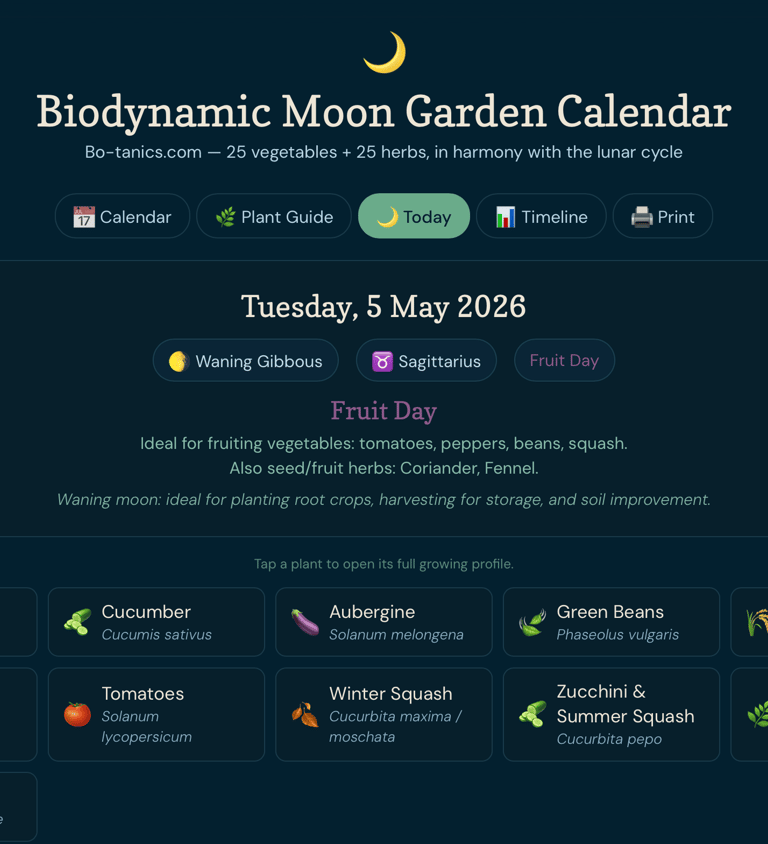
This is exactly why I built a herb-specific biodynamic calendar. Rather than working out which of your 50+ plants fall into which day-type category each season, the calendar does that calculation for you and shows you which herbs have open windows today.
If you would rather not work it out every morning, you can find the calendar at bo-tanics.com or scroll down for more details.
Further reading: If you want to go deeper into the underlying philosophy, Maria Thun's The Biodynamic Year is the primary text. For a more scientific perspective, the work of researcher Hartmut Spiess offers a useful evidence-based companion to Thun's observational work.
Want to go deeper?
Our full Biodynamic Moon Garden Calendar combines lunar phases with zodiac timing, seasonal planting guides, and day-by-day growing advice.
Everything you need to garden truly in tune with nature - available below for €19.
The Biodynamic Moon Garden Calendar
The Biodynamic Moon Garden Calendar is available at bo-tanics.com
One-time purchase.
Yours for every growing season ahead.
Bo-tanics Aroma-Herbary
W E L C O M E T O T H E G A R D E N

© bo-tanics.com 2026 design by thebodesign.com Privacy Policy Terms & Disclaimer