What Would You Do If the Pharmacy Was Closed?
HOLISTIC HEALTH
Bo-tanics
4 min read
It's a question most of us have never had to answer seriously. And yet.
A Sunday evening. A bank holiday weekend. A child with a raging temperature and a cough that won't settle. You reach for your car keys, drive to the pharmacy, and it's shut. The next one is thirty minutes away. The out-of-hours GP line has a two-hour wait. And all you want, in that moment, is to do something useful for your child.
Sound familiar?
Most of us have been there in some version of this. Not in a crisis. Not in a disaster. Just in the ordinary, inconvenient reality of life not quite running on schedule. And in those moments, what you know, and what you have to hand, matters enormously.
We Outsourced Something Important
For most of human history, every household had a working knowledge of plants. Grandmothers knew which hedge to strip when a child had a fever. Farmers kept dried herbs through winter for wounds and chills. The kitchen garden was also the medicine garden, and the two were never really separated.
Then, over the space of roughly two generations, we handed that knowledge over entirely. We traded it for convenience, for consistency, for the reassurance of a label with a dose printed on the side. And in many ways, modern medicine is extraordinary. It saves lives every day, and none of this is an argument against that.
But somewhere along the way, we also lost something. A quiet confidence. A sense that we could look after ourselves and our families in the small, everyday moments that don't require a hospital, but do require knowing what to do.
The Gap Nobody Talks About
There is a gap between "nothing to worry about, it'll pass" and "you need to see a doctor," and most family health moments live right in that gap. A child with a bee sting and a swelling knee. A partner with a chest cough that has dragged on for ten days. A teenager who can't sleep because of exam anxiety. An elderly parent whose digestion has been difficult since a course of antibiotics.
These are not emergencies. They are not nothing, either. And for most of human history, plant medicine was exactly what filled that gap.
The knowledge hasn't gone anywhere. It's just been forgotten. And it is entirely possible to reclaim it.
This Isn't About Fear. It's About Confidence.
I want to be clear about something, because there is a version of this conversation that leans into anxiety and dread, and that's not what this is.
You don't need to believe the world is about to collapse to want a better-stocked pantry. You don't need to distrust medicine to also want to know what willow bark can do for a headache, or why a yarrow poultice has been used on wounds for thousands of years.
You simply need to believe, as I do, that knowing how to care for your family is one of the most grounding, empowering things you can do. Not instead of modern healthcare. Alongside it. With discernment, with knowledge, and with a pantry that actually has something useful in it.
What a Prepared Family Shelf Looks Like
It doesn't have to be complicated. Twelve herbs, grown or bought, properly stored and understood, will cover the vast majority of everyday family needs. Cuts and stings. Coughs and colds. Fever management. Digestive upsets. Sleep and anxiety. Mild infections.
These are the plants I come back to again and again in my own practice, and the ones I teach:
Yarrow for wounds, bleeding, and fever.
Garlic as nature's most robust antimicrobial and immune supporter.
Calendula for skin healing and antiseptic care.
Thyme for the chest and persistent coughs.
Ginger for nausea, digestion, and inflammation.
Chamomile for sleep, anxiety, and children's ailments.
Lavender for stress, burns, and skin irritation.
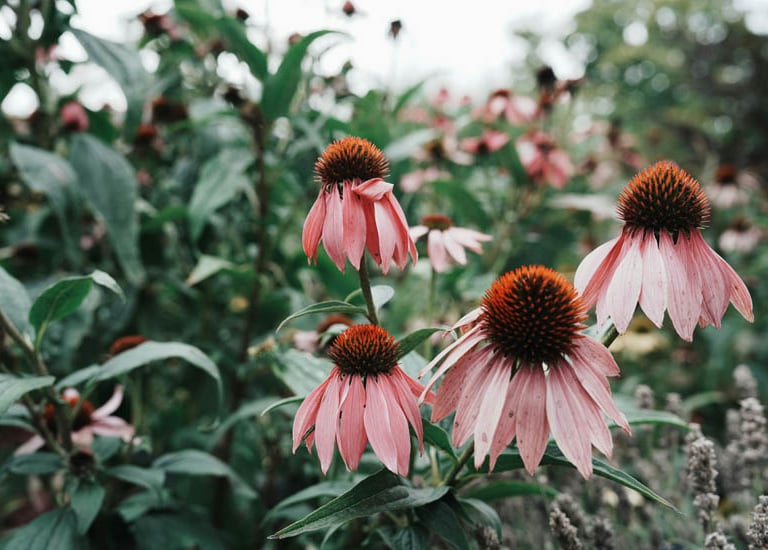
Echinacea at the first sign of acute illness.
Mullein clears mucus and calms lung inflammation.
Lemon balm for stress, shock, and emotional balance.
Peppermint for headaches, digestion, and nausea.
Rosemary, so often thought of only as a kitchen herb, for circulation, concentration, and the kind of deep muscle ache that settles in after a long difficult week.
None of these are exotic. Most are already growing near you. All of them have centuries of documented traditional use, and a growing body of modern research behind them.
Learning to Use Them Is Easier Than You Think
Making a herbal tea is not different from making any other tea. A simple tincture takes about ten minutes of hands-on work and six weeks of patience. A calendula salve requires nothing more than olive oil, beeswax, and a jar. A poultice is just a plant, lightly prepared, applied to skin.
These are not lost arts requiring years of training. They are practical household skills, the same kind of skills that used to be passed down through families, and can be again.
Start Where You Are
You don't need to do everything at once. You don't need a perfectly stocked apothecary or a working herb garden by the weekend. You just need to start somewhere.
Plant one thing. Learn one herb well. Make one preparation. Notice what it does.
Because the question isn't really "what would you do if the pharmacy was closed?" The real question is: what would it feel like to know the answer?
Please note: Herbal medicine is a powerful and beautiful tradition, but it is not a replacement for medical care. Always seek professional advice for serious illness, if you are pregnant, breastfeeding, or on prescription medication, or when a child is unwell and you are unsure. When in doubt, consult a qualified practitioner or your GP.




Bo-tanics Aroma-Herbary
W E L C O M E T O T H E G A R D E N
© bo-tanics.com 2026 design by thebodesign.com Privacy Policy Terms & Disclaimer